
By Lawrence Krayn
I’d dropped in on John unexpectedly. He hated that.
Of course, he’d done it to me a thousand times. But over the years he’d grown to detest our mutual spontaneity. He’d outright shunned it later on. I suppose eventually he’d grown to neglect the friendship all together, but that was of little concern these days.
“These friggin’ plants are dying”, I remarked, glancing toward the ’96 Dallas Cowboys commemorative plaque he’d insisted on keeping since childhood. It was peeling and weather-torn, though I suppose it served as a reminder of better times. I held my tongue, literally and cerebrally, regarding its current state of disrepair. Afterall, he hadn’t been expecting my company.
I was in town for an appointment I’d been putting off for two years that I’d set up for that Friday afternoon, figuring I’d get an early start on the weekend and would spend the night at my mom’s. It was the week after my birthday, and the years until 40 were quantifiable on less than one hand.
I’d been struggling. After an intoxicated whirlwind of a weekend on the lower east side, I’d come down with a terrible and abrupt case of laryngitis. The rasp of my struggling voice in investigative interviews all week was bad enough, but more cruelly, the illness had enveloped my inner-monologue in a dense, dark fog. As my skull throbbed with morning headaches, acute mid-life crisis stabbed and panged at my lucidity with nightmarish fading memories and visions of a pitch-black path to nowhere.
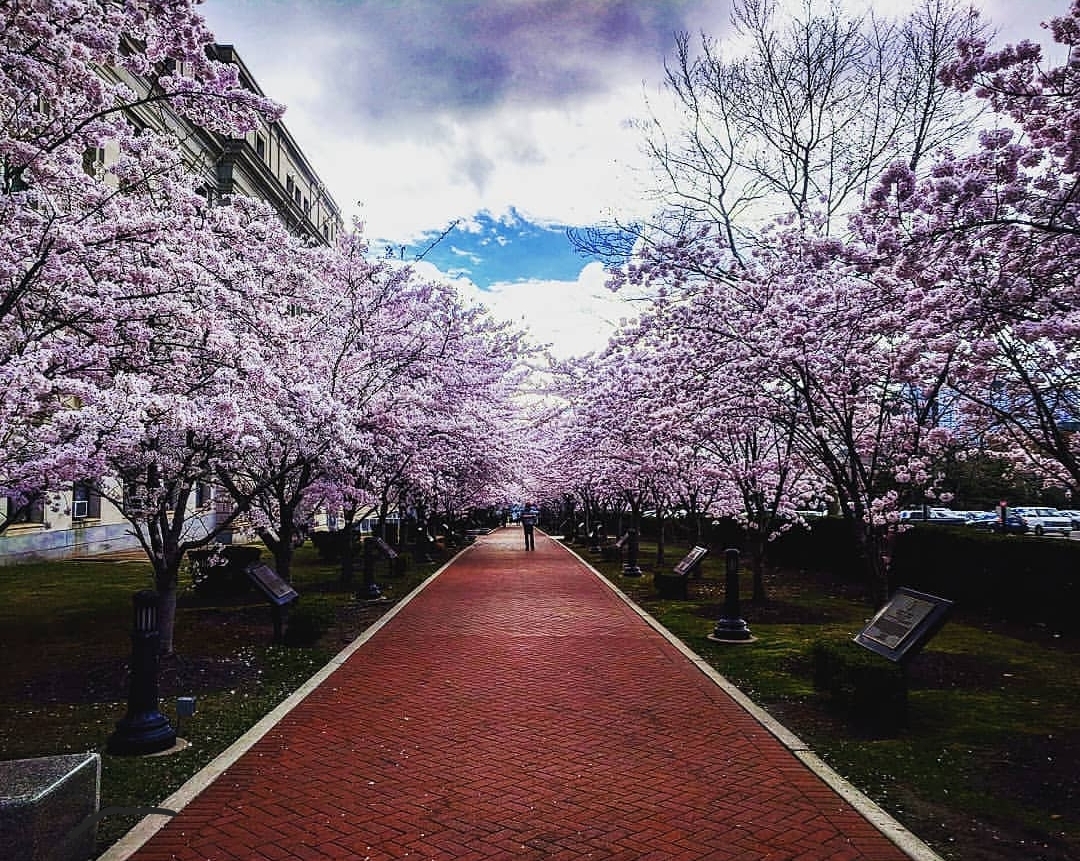
Prednisone and a daily bio-bomb, 500mg of azithromycin, had the mist only slightly dissipating by the time I’d left my appointment downtown. The place was nobody’s big city, but it was nobody’s little village either. Gliding through backstreets I’d rarely traversed in my youth, I sensed a familiar dust. It was the incleansable embedment of a northeastern industrial past, painted over with a thin coat of immigrant vividity. It was a reliable silhouette every season, on the days I cared to pay it a visit. The revival coupled with the late April blossoms dispersed amidst the main drag transfixed me, bringing me into a numb state of calm. Over the course of a few leafy intersections, my sun-roof slid open, and a fuchsia of fresh pedals cascaded over the avenues.
There’s a railroad bridge past some concrete yards and tile places on the west side. They say Washington marched there, but I’ve been led to believe that Washington walked upon every square inch of every town in Jersey. I was stopped at the light under that bridge, gazing at its 19th century brickwork, when I’d realized I was in a mood that wasn’t suited for talk radio. Switching to Bluetooth, I tossed on Coltrane’s “Tunji” as I turned left, cruising out through apple orchards and preserved fields.
Pollen touched the breeze with a sweet potpourri. Tyner’s B minor 7 chords slowed the early afternoon. It was as if I’d released the week’s bustle and left it behind someplace further up the highway. Only then could I be immersed in my existential musings, free from judgment or the petty nagging of mundane tasks. Jazz seemed to have that effect, wherever and whenever it floated. Some say it was dead. But no, it lived on and endured, staying timeless with a transcendent appeal through decades and generations, whether vintage or brand-new, blurring time.
I’d planned to head to an upscale supermarket to grab a steak. I figured I’d toss it on the grill over a beer in my parents’ backyard. How quickly I’d taken the chair of my mother’s father, shucking clams and sipping a brew on weekends by the pool. How quickly he’d vacated it. I was wearing dark blue slacks with mahogany-brown dress shoes and a white polo. My usual two-toned watch and the humble ring on my right pinky being the only accents. The garnish of age tended to suit me well despite my internal angst, and I wielded it confidently in moments of less assailing logic.
At some point, the muted comfort of the drive mixed with the music got me drunk on nostalgia. I used to drift into those spaces more often some ten years ago, when walking amongst old buildings could evoke a trance, as if all of time surrounded me at once. It was harder to find those moods now though. They grew more elusive as one aged, like the ecstasy of Christmas. Needless to say, the onset and spontaneity of the feeling was welcome, and it inspired further detours. I’d stop by grandpa before heading home, after I’d dropped in on John to have an overdue conversation. It really had been too long. I’d been putting off seeing him. I’d been procrastinating generally. It made me feel like I was losing control.
My mind wandered between a sense of accomplishment and dissipated time, as thoughts derived of lost years floated over Bobbi Humphrey’s “Blacks and Blues”:
You make your many moves,
until you find your groove.
You’d rather win than lose.
The chances, don’t come in twos.
But when it’s your time…
to choose,
You have paid your dues.
They come in blacks and blues…
Blacks and blues…
Blacks and blues…
The parking lot was busier than I’d expected it to be on a weekday. Most of the customers were my parents’ age but they looked to me the age I perpetually pictured my grandparents as. A woman or two who worked there caught my eye, but I reasoned that they must be in their early 20s and therefore babies. How odd, the same physical setting, this store, had no memory of me as a baby. But I was a baby, and I was here. I’d insisted this to myself many times as of late, and sometimes I’d even write it in ways so abstractly creative that I thought the mindless inertia of the tangible world might give up its stubbornness and acknowledge me. Since time was a vapor rather than a window though, it never did.
I thought back to when the store had first opened. John, also a baby then, had worked in frozen foods. I glanced down at the floor strolling through a set of automatic doors, hiding my reflexive smirk through the entrance. I couldn’t help but think back to when I’d dropped in on him. We used to give his manager a hard time, and we’d make jokes about the customers. Walking through the produce section, I thought about how the kids working there now probably saw me the same way I’d seen that manager and those customers then. 20 years felt like just a few months.
The thoughts wouldn’t have been so intrusive had I not been struggling with age all week. Well, not age but aging, or, not aging per se, but moving through a second grand transition. I could feel life pulling me into its next phase, and unlike the last time, this time I was acutely aware of the consequences of a closed chapter. I’d never be able to flip backward through the pages. Worse, I’d never have the opportunity to rewrite them. Once you’ve woven a certain amount of canvas, you start to lose the control you thought you had over the plotline. I wasn’t sure I’d done very well with this particular canvas, and now I wasn’t sure I wanted to see it through at all. It felt irrelevant, and to be going in uncontrolled, fleeting directions.
Insulated glass gave a refracted view of a row of tantalizing ribeyes interspersed with the commanding presence of a grown man. I was in awe of his reflection and the way it had come into its own. I knew him in a way different than he looked, and only sporadically believed I belonged in control of his physical iteration. Still, watching that image select the night’s steak on a whim, while a humble flex, was alluring.
I was envious of the young man who emerged from the back, chuckling to someone he’d left behind the door. I felt both sorry and happy for him as he politely plucked my chosen cut from within the case and wrapped it neatly on the scale. All the options he had, all the time, all still the likelihood he’d end up like me.
I thanked him in a tone half as if I was calling him “son”, and half like a cool uncle. As Michael McDonald’s “I Keep Forgetting” played over the p.a. system, I browsed the seafood section. Unsuccessful in my attempts to come up with a fictional occasion worthy of a lobster tail, I made my way to the register. My wallet and waistline were granted a rare reprieve, and I picked a lane with only one customer and a diminishing amount of groceries on the belt. The cashier did not look the chatty type, which I liked. She appeared to be in her early 50s, vaguely pleasant, but with a wary face and a hat pulled low over her eyes.
I offered the customary pleasantries while arming my debit card and placing the steak on the belt. Quickly bagging it, I paid promptly and reached for the receipt. She took it from the printer and kept it in her hand. Then, she started to slowly back away from the register, expression and eyes still mostly hidden under the low brim of her hat. My depression had been weighing on me all day and I was a bit impatient, but the reminiscent mood negated any coarse comment. The whole action moved much slower than is customary, but I just stood and waited…
Nothing.
She hadn’t even begun to reach her hand out. She was almost just standing there. Luckily the customer behind me was still tossing plastic bags full of fruit on the counter and hadn’t seemed to notice. Still, if it wasn’t for curiosity, I might have just turned and left.
Finally, to my introverted horror, she walked around the bagging counter toward me. I had no clue why she was doing this, or what she might have to tell me. Puzzled, I stood there and instinctively lent my ear as she leaned toward me and passed the receipt from her right hand.
“I love those shoes…” She said, in more than a whisper but less than a public declaration. “All men should wear those shoes. No one does anymore…”
I reflexively smiled and managed, “Thank you…I try to keep ‘em nice”
She smiled back, and finally looking me in the eye, said, “Handsome too.” She then handed me the receipt and returned to her post.
I managed a genuine smile as I walked from the store. Perhaps age and its fermented stature hadn’t just been thrust upon me. Perhaps, to some extent, I’d actively pursued it. For all my adolescent envy, those types of compliments, that manner of dress, would never have been possible as a youth, when I had no real control or masculine grace; when I’d had no money. Maybe I could be comfortable here for a while. Maybe this was the culmination of all the confusion and ambiguity which had ultimately been pieced together into a man, if not the perfection one might imagine as a relevant legacy. Before the unexpected compliment, I’d been certain I’d begun my descent from the hill, but now I thought, I may well be just shy of its apex.
It wasn’t the apex that I’d feared. The apex was a societal pillar. It was to be revered and respected. It was the descent that I’d begun to resist with so much loathing and dread. From all the deferential treatment, compliments, and admiration, emerged a once again vulnerable and dependent soul to be disregarded; smiled at with perceived useless innocence. It was as if we simply couldn’t believe that the elderly were ever in charge, but I knew that they had been. I was obsessed with their old films and photographs, and I’d seen them there, sending ominous warnings through dimensions.
Strutting through the parking lot, I tossed dinner onto the passenger seat and slid behind the wheel, turning the ignition. Ahmad Jamal’s “The Awakening” was queued up and began diffusing its thudding baritone chords against the interior. Gliding between tenor solos and windswept pedals, I embraced the same backroads and the same ancient breezy scents that my grandfather had at my age, not that long ago relative to the age of this place, in an older model car, amidst older fashions and newer buildings. I’d seen that version of the world too, 33 years ago from my father’s backseat. Things froze for me right then, for the first time in a while.
It was a good thing, because the abrupt pace of one’s early adulthood could cause emotional whiplash. Oft mornings I’d find myself scrolling through Google’s suggested memories; photographs from years that had never occurred to me to be of the cherished class. I’d see myself, baby-faced and naïve, more concerned with the goal than the journey, and I’d wonder if those unremarkable days were intended to be a part of my catalog in the way a sentimental film montage portrayed the passing decades of an aging character. If they were, it seemed less potent than it should have. For one, I barely remembered the vast majority of those weeks and months. Second, they were primed to vanish in the most fleeting of ways, since some of the friends appearing in them were gone or different people. The images themselves didn’t even exist, really. They were digital data.
Memories used to take the form of actual, tangible, photographs. At least in those days there was the chance that some faded polaroid might end up, without context, in a flea market, or in the attic of an abandoned house, or that some new species might dig it up from the barren earth after the sun had burned out. It didn’t matter that a later set of eyes probably wouldn’t have been able to glean anything of my life. At least I’d be leaving some sort of evidence, and severed from the totality of the story, it might take hold in some imagination; a particle taking on a new existence, artfully connecting what was with what is without explanation.
But these digital imitations of photographs, they existed in a universe all their own, one that would no longer be accessible to us the second our cellular portals ceased to function, or upon the end of me, with no steward for my password, and no one with much interest to peer inside. They’d hang for eternity, or for the life of a server, in a vacuum, like a bank account to which no one had access. I had a profound understanding that those captured moments would be lost, along with the stories and memories behind them. And if any of the images contained the derivatives of an experience shared by two, the record would be forever lost upon their mutual departure.
I headed straight to John’s after buying the steak, my mood elevated by the compliments of the cashier. We’d reminisced about the supermarket, laughing over the pranks we’d pulled and discussing how we’d both been babies then. Still, something about his current situation pulled me from the serendipitous present.
“What’s the point in the end?” I asked.
Him not answering right away, I continued with my thought,
“It’s like your whole generation moves through this cyclical process together…you all exist just once. Your heroes, your famed, your nefarious, your irrelevant. The one’s who were pillars of your city and their counterparts in towns across the world, whether you’re ever cognizant of their existence or not. You watch the world turn; historical events unfold before the lot of you. Childhood, adolescence, middle-age, none of you know how to handle it. Before you can wrap your heads around it, you’re all gone; a whole chapter in human existence, a whole world of people, entire sociological ecosystems, passed through. Maybe you get some street sign named after you, maybe some bench on the boardwalk, maybe they knock down the physical silhouette all together, and everything vanishes completely. I mean, I’ve seen it. All over Newark: vintage photographs now empty lots …”
I stopped my inner-monologue as a small pickup truck passed behind me. I thought it might stop and interrupt us, but the elderly driver turned past the church and exited through the same gate I’d come in through. He did not wish to be paid mind, nor did I wish to mind him.
Turning back toward John, I read his headstone.
“1985-2011”
26 years old. He was still a part of our story. He’d go on that way, a part of our collective consciousness in this town, an integral character who’d made an early exit in the prologue of a generational novel that would eventually be closed, and over time, disintegrate.
He’d chosen that early exit, going out in a crime scene, taking no one but himself with the pistol. I’d sometimes wondered if he’d been spared anguish in the long run. Afterall, what good was a scratched-up plaque on a boardwalk bench when the winters left it dark and isolated, desolate waves beating up on the ice-cold sand, and eventually no one could even discern the name, or would want to if they could?
But was any of that important? No more important than the numbers on the stone. They weren’t of any substantive value themselves, but a reference to something profoundly valuable to the individual laid before them. Those 26 years were important to John. They were important to me, and whether anyone ever acknowledged them or not, they had existed. I had updates to inside jokes that only he’d know about, like a dangling thread cut short, living solely in me.
Standing there in the quiet cemetery, I’d pivoted fully from the mood I’d started with that morning. I realized I’d been depressed because I’d been riding through time without paying it its proper due recently. I should be more deferential to every fleeting moment I thought, placing a small rock atop John’s headstone, as if time itself might take note of the fact that he was still a part of the circle of the living rather than a relic. I’d thought about abandoning it because I hadn’t been appreciating it for all that it was worth.
There is a certain tragic beauty in being cognizant of our own inescapable life-cycle, and fathoming at which point we are therein. I suppose such hopeless acceptance could manifest as a knowing confidence. It was that same confidence that the cashier had picked up on, herself a member of the club. I knew this all too well, taking time, or sparing time as a consequence. None of it was expendable, all of it unique and delicately finite, perpetually fleeting.
I moved the ’96 Cowboys plaque to the right side of John’s headstone, so that his name and time were clearly visible. I figured one of his brothers must have left it there some time ago given the state it was in. Lending one last glance, I turned, silently acknowledging other rows of souls as I made my way back to the car.
I only had to follow a narrow, winding road a few yards through trees bearing white blooms to make it to my grandparents. I peered toward 18th and 19th century graves, whole generations gone together. No one to visit them, seldom given thought, the prominent laid beside the obscure, all staggered but everyone caught up nonetheless. “It Never Entered my Mind” caressed the light breeze whispering through the crack in my window. Miles had only been in his late 20s when he’d recorded it, my grandfather would have been in his late teens upon its release.
I turned the volume way up and sat in silence. I was sharing a moment with the fallen. My grandfather had always told me, in his New York City accent, that his favorite music was “the ‘50s jazz”. It still existed, as did he, to which I’d made sure of. He’d never finished any of the stories he’d started writing though, and so I’d made it my business to churn out and finish whatever I could.
I don’t think John would’ve been able to answer my question. The definition of a purposeful life is relative, and complete fulfillment futile. But there are days when I make peace with time. There are times when I embrace the passing days. Every now and then, I just need to come home, and hear jazz on a Friday.
Lawrence Krayn Jr. is a Newark resident and lifelong New Jerseyan. He graduated from Rutgers University-Newark with a B.A. degree in Political Science and received his J.D. at Rutgers Law School-Newark. A practicing attorney by day, Larry spends much of his spare time engaging in creative projects. He sees Newark as a vibrant hub for the arts, and is an avid fan of various local creators. He has been a musician for many years under the moniker “IL Lusciato”, and hosts a weekly live podcast on current events, entitled “The Logic and Larry Podcast.” Whether fiction or non-fiction, his writing is heavily influenced by his immediate surroundings and his own life experiences.
 The Newarker