
By Lawrence Krayn
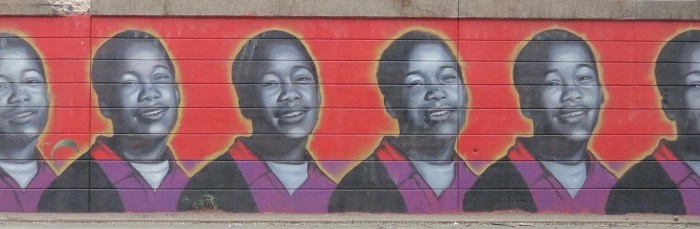
From the opening paragraph of its prologue, written by Rutgers Professor Whitney Strub, who also served as the book’s editor, Queer Newark—Stories of Resistance, Love, and Community ties modern art and activism to historic perspective and struggle. Making reference to the tragic story of Sakia Gunn and the mural on McCarter Highway that currently bears her image, Strub lays out why Newark LGBTQ history is distinguishable from more common reference points, derivatives of places like New York City and San Francisco. As he tells it, Newark is and was a working-class city. It is a city molded by immigrants and shaped by the struggles and activism of people of color. Therefore, Newark’s LGBTQ history and current existence has been borne of those paradigms and intertwined with all of the challenges and complex circumstances that come with them. It deserves a comprehensive look of its own.

Comprehensive is certainly one way to describe the project. Running more than 300 pages (including citations and acknowledgements) and featuring contributions from Strub, Peter Savastano, Timothy Stewart-Winter, Anna Lvovsky, Yvonne Hernandez, Kristyn Scorsone, Jason Chernesky, Leilani Dowell, Dominique Rocker, Yamil Avivi, Danielle Shields, Carse Ramos, Mary Rizzo, Christina Strasburger, and Zenzele Isoke, Queer Newark goes everywhere from accounts of curious 1920s runaways to the modern lives of successful Ironbound residents. The work is largely chronological and interspersed with oral history and photos, giving first-hand glimpses both visually and verbally into Newark’s LGBTQ scene over time.
Recounting the earliest parts of that timeline presented some challenges. As the book discusses,
the community faced marginalization at a more pronounced rate in the 19th and early 20th century, making first-hand sourcing difficult. As Savastano, who contributed to the portion of the book dedicated to that period states: “Back then [anthropologists] did no fieldwork, and relied on the writings of missionaries, colonial administrators, and soldiers, etc., as their primary sources. This means that we have only written, visual, and perhaps even musical sources to rely on.” Savastano further explains that many of the writings could be critical of the community, coming from police vice squads and religious figures who might be writing sermons condemning certain activities and behaviors. Nonetheless, these sources provide for some concrete specifics on places of congregation, names and dates, and to perhaps a lesser extent, the recounting of actual activities. All of this information is present in the book and quite an interesting read. Savastano also highlights that much of the history would be contained in personal diaries, letters, and postcards, and existed in coded language, symbols, and images which presents its own obvious challenges. Given these hurdles, the amount of specific and descriptive history in Queer Newark is legitimately impressive. The sourcing, including descriptions of notable venues accompanied by photographs of city blocks long gone, also punctures the academic gloss and gives the work a poignant intimacy.
Unearthing history is not the only challenge presented when discussing Newark and its LGBTQ
community. The city, being so often defined in its modern iteration by racial and ethnic conflict and
activism, offers quite the case study on intersectionality, and it is not always a neat conversation. While much of the late 20th century and even early 21st century discussion on LGBTQ oppression and activism has centered on cis-gendered gay white men, Newark presents a situation where the community has also had to grapple with racial and gender discrimination. To that end, Queer Newark provides an unencumbered and nuanced conversation. One of the most interesting sections of the book delves into the new left and black power movement, which most recognize as having largely predominated in the 1960s and early 70s. The work points to both allies and hostilities toward the LGBTQ community within the movement, and offers nuanced if not complicated discussions of the literary and personal histories of figures like Amiri Baraka as they pertain to the subject. Like Newark itself, the book offers a deep glimpse into the interactions between and among marginalized groups, many of whom possess dual identities and must grapple with the complexities presented in certain forms of activism.
The book winds through the decades artfully, and those attuned to sociological history will recognize an evolving set of issues, some relatable to nationwide LGBTQ concerns, some to urban post-industrial cities, some to both; sometimes in an oscillating friction. In a particularly thought- and debate-provoking seventh chapter, Leilani Dowell delves into the philosophical and practical complexities of black queer women navigating spaces, both in the geographical and the social sense. Therein, we discover a mind-bending interplay between feelings of safety, oppression, and identity regarding Newark’s “G corner” and New York City’s “Village”, gentrification and the projects, policing, capitalism, and a litany of other things, all tied to race and sexuality. Newark begins to take shape as profound crossroads, warranting continued intensive study.
Like most sections of Queer Newark, Dowell does not rely on macro-generalizations to explore
the topic at hand, but rather gleans perspective from the individual experiences of actual Newarkers. In that sense, the work is more a comprehensive tapestry than a single aimed photograph. Newark is a diverse city in more ways than one, and each aspect of it presents a unique angle. Yamil Avivi, who contributed the ninth chapter, which explores Market Identities and Queer Community-Building in the Brazilian Ironbound, describes Queer Newark as “serv[ing] as a model for serious historians . . . wanting to amplify a city narrative from a queer or color perspective in a collaborative fashion with different voices, to reflect the diversity of any city.” Avivi, who said that he conducted ethnographic interviews for his piece and protected the anonymity of his subjects, was quick to point out that the Ironbound was unique both to Newark and the wider region. While influenced by white LGBTQ “mainstream” culture, the LGBTQ community in the Ironbound is also heavily influenced by Lusophone and homeland culture, and interspersed throughout the neighborhood rather than confined to a specific enclave. An interesting interactive friction within the Ironbound involves cultural norms, pressure to maintain the marketability of the neighborhood as a destination for outsiders, and the pressures and fears that come with immigration and some people being undocumented. On the one hand, the cultural richness provides for an immersive subculture within a greater social network, on the other, some of the cultural and legal restraints place limits on activism and organization. Not unlike other neighborhoods, and Newark itself, its quite complicated.
Our city is rich in history. Today’s Newark looks and feels very different from the Newark that existed before excessive urban renewal, deindustrialization, and the suburbanization of the region. What has endured for the better part of two centuries, through struggle and resilience, are the evolving communities that continue to exist as part of its urban fabric. Queer Newark is a work adept at weaving academic research with personal histories in a way that amplifies the legacy and trajectory of the LGBTQ community in Newark and their embedment in the fabric of the city, both past and present. That work continues tangibly, via things like a carefully designed walking tour, outlined in the eleventh chapter by Mary Rizzo and Christina Strasburger, and the continued academic and journalistic work that Queer Newark aims to inspire. As Reginald Bledsoe, Director of the Essex County Office of LGBTQ+ Affairs, told the Newarker: “This collection sheds light on the diverse range of voices and experiences that have contributed to shaping our city, emphasizing the importance of recognizing, preserving, and celebrating the cultural contributions of LGBTQ+ individuals.”
The work is a thought-provoking and interesting read, which packs a number of wide-ranging perspectives and history into its manageable 11 chapters. Providing intimate glimpses and provoking abstract philosophical thought, it is well worth the read.
Queer Newark – Stories of Resistance, Love and Community is to be published February 16 by the Rutgers University Press. It will be available in paperback, hardcover, and in digital formats.
 The Newarker