
by Katie Singer
This article and the dialogue comes from an interview conducted in 1997 as part of the Krueger-Scott African-American Oral History Collection. The collection can be accessed at https://kruegerscott.libraries.rutgers.edu/.
Louise Epperson lived what she called “a quiet life.” Her plan was simple. She aimed to retire from her job as an occupational therapist at a school in Staten Island and live a cozy life at the home she purchased on 12th Avenue in Newark’s Central Ward. However, a headline in the January 1, 1967 issue of the Star Ledger irrevocably changed those plans—and the history of her community and the city at large.
The New Jersey College of Medicine and Dentistry (NJCMD) announced its intention to expand its campus right into her backyard. As Epperson explained in a interview:
[The headline] said that this school was gonna move into Newark regardless of what anyone said . . . and first thing they were gonna do was to blight all the land that they wanted. And they wanted something like over three hundred acres of land at that time. And they had already blighted part of Twelfth Avenue where I lived, and one side of the street was blighted. And they called that urban renewal. Well I say it looks more like Negro Removal than urban renewal, you know.
Those most affected—largely African-American and Puerto Rican—had been left out of the conversation, people just like Louise Epperson who had purchased their homes and staked their lives there.
Immediately, Epperson began to organize a counter-campaign. What started out as meetings at her kitchen table with a few neighbors evolved into the Committee Against Negro and Puerto Rican Removal. Meanwhile, it quickly became apparent that negotiations between NJCMD and City Hall had been going on for some time. Epperson said:
[W]hen they do that, it will be over my dead body. I will not stand for that. So I started to go out from door to door. From climbing up the third and fourth flights asking people to come out, and let’s have a meeting and talk about it. . . . [Mayor Hugh] Addonizio was who we were fighting.
At the required planning board meetings (subsequently called the “blight hearings”) held by the city, the community showed up en masse. Despite the resistance to NJCMD’s plans, residents had already started moving out of the neighborhood affected by the planned expansion.
Right in the middle of this fight, the rebellion of July 1967 erupted. The six-day uprising garnered the kind of national attention the city did not want. Mayor Addonizio attempted to quell the bad headlines that quickly branded their town a full-on war zone. Leaders in City Hall were fearful that yet another “race riot” would follow even after the present uprising ended. They wanted to attempt to appear as though they were listening to the demands of the “rioters.” And, some of those demands concerned the medical school development. Governor Richard Hughes sent two buses to Newark, inviting Epperson and her supporters to ride down to Trenton and talk with him. As Epperson remembered:
When I started the fight with the med school, I tried to get everybody in the city and the state and the county and the federal government to help me. Everybody gave me the runaround. . . . Then the riots broke out. Everybody that I tried to contact before this happened, everyone, everyone, including the Governor, including the president from the College, Dr. Cadmus [head of the medical school program], including Chancellor Dungan, Paul Ylvisaker, they all came to my door.
The outcome of this eminent domain fight was the Newark Agreements. These agreements included a decrease in the hospital’s land allocation which would have displaced approximately 20,000 African-American and Puerto Rican residents in the Central Ward. There was a moderate increase in financial subsidies for those who would be displaced by the project as well. Eventually the hospital was built on 58 acres, much less than the initially proposed 300 acres, and even less than the 150 acres secretly pledged by Mayor Addonizio to the medical school in early 1967. In addition, 60 acres in nearby neighborhoods were to be “relinquished” expressly for new and affordable housing.
Notwithstanding, numerous families suffered from the effects of relocation. But because of the work of Epperson and a handful of other local activists, more people received better compensation than was initially promised. She eventually received a job offer from the very hospital against which she had organized. After initially declining, she ultimately accepted the position of Director of Patient Relations, after some community encouragement to take the position. This job allowed her full access to Dr. Cadmus and other college administrators. As she related:
I went home, and I thought it over and I prayed on it. I decided to come to work for the College of Medicine and Dentistry—providing that I had an open-door policy: I could go direct to the President anytime I wanted.
As predicted, Epperson could be seen marching into his office on a regular basis to bring issues brought by individuals in her community to light.
Epperson’s story is an example of the thousands of undertold stories of resistance from that era of Newark’s history. Her efforts left an indelible mark on her community, one that can still be seen in the area around what would become Rutgers Medical School—the successor to NJCMD. She continued to be a committed advocate in the community until her passing in 2002, at 96 years old.
Katie Singer has a Ph.D. in American Studies from Rutgers University-Newark. Her book, Alien Soil: Oral Histories of Great Migration Newark, which is based upon the Krueger-Scott African-American Oral History Collection, is due out August 2024 with Rutgers University Press.
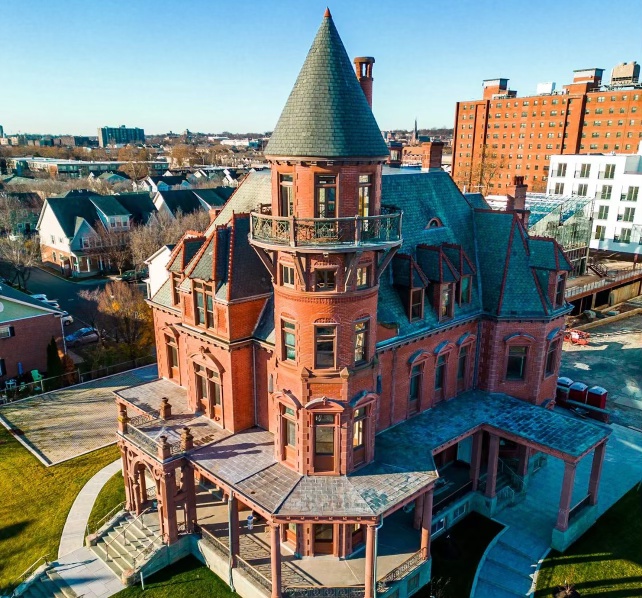
Image courtesy of @newarknjblog
 The Newarker