
by Lawrence Krayn
I was there once, before I died.
I was here for a while too.
I don’t know how you found this. Maybe it was buried in a file floating around an old server someplace. We called it “the cloud” back then. Poke around, you might find some of the other digital artifacts we left behind. We weren’t as primitive or as misguided as you might think. It’s just, time has a way of making young things ancient. I bet you’re sure that nothing new is ever a misstep either, just human advancement in perpetuity. I assure you though, you’ll think about it differently when you’re next in line; those kids in the back don’t seem as wise anymore.
Assuming you know about Newark, I’ll tell you that this was in the early 20s, right around the time Mayor Kenneth A. Gibson Boulevard got its name. Before then, people just called it Broad Street. This was before the skyscrapers. The few that we did have were concrete, and there wasn’t as much metallic glow. Believe it or not, Newark had lost a good portion of its brick and wood density after the 1980s, and for thirty or forty years a lot of it was low-rises and surface parking lots for gasoline-powered cars. You could still see Manhattan from the roofs in those years.
I’d forgotten where I was for ten hours, actually. It wasn’t until I caught a glimpse through a window, seeing the modest skyline of University Heights, that I realized I wasn’t far from home. It’s odd how places can look so different based on perspective and orientation. I’d never been to Saint Michael’s Hospital before. Though I’d passed by it a thousand times, it was something of a prop to me. I’d always seen it from the outside, just another building filled with extras. Now inside, I was the prop that no one knew.
The hallway was cold and the lights took on a yellowish glow. I’d lost all sense of what time of day it was. People waving their “hellos” and clutching cups of coffee gave slight hints that morning rituals were afoot, but to me it felt like the middle of an endless afternoon.
The room was comfortable enough, with News12 providing some faded connection to the life I’d left behind. A young man and woman in their twenties bantered with a woman my age. They were polite in a generic way as they wheeled me into a cold, small room and guided a wand over my chest that hurt in the ways they’d press it. I didn’t object. I didn’t want to be an impediment to the images of my heart, nor to their conversation. I was one of ten that day, maybe twenty. My identity was no more of interest than the old woman before, or the poor man beyond.
They were talking about a criminal trial. One of them had been a juror. I thought to interject, given that I’d long been the prosecutor, commanding the room in the same courthouse they spoke of with a misplaced confidence, evincing only a vague understanding of what they’d seen. I decided against it though. My current state of dishevelment disqualified me from any such credibility. My hair was thrown about in ways that made its thinning more obvious. My underarms smelled of body-odor. My face hadn’t been shaved in days. That notation: “Obese,” had at last transcended from a description in medical records to becoming my own self-image.
I imagine that if I’d spoken up they would have acknowledged me. They might have laughed at the way I segued, or found common ground in a court officer we both knew. But the youngest amongst them was re-doing some of the scans, pressing her cold wand between ribs. They’d told me they’d needed a few additional images, but it was obvious she was just in training and that I was the day’s crash dummy. It was fine. I didn’t care to mutate into a human. Breathing background mannequin was fine for where I was, a guest on someone else’s scene.
Purgatory. It is a world residing in the mind. Its not so much a place, rather a glimpse outside existence as it passes you by. The social habitat in which I was such a focal point, within the confines of which we’d joked and claimed Newark to be just a small town, was a narcissistic illusion. Really, it was a Rubik’s cube, a matrix wherein we occasionally detoured into adjacent dimensions. Come home one block and a single alternate turn from your normal routine, and the infinite unexplored corners of the ecosystem are jarring. How many other worlds make use of the same avenues, strange faces in the most familiar a place?
It was obvious when I’d met the doctor. His ambling about the hospital no different than mine about the courthouse; blocks away, universes apart. I’d told him about the last two times my erratic muscle had spun me into breathless despair, each out of town. That’s when the nurse standing beside him asked me the reason I’d been visiting Newark. The way she posed the question, I could tell that it came from the same place as I derive my greetings to nervous Penn Station tourists. How had I wandered into her Newark? And who was I but a passing forgotten face lost in an infinite stream of weekdays? A city to which I was so vital was a city to which I had no place at all.
I stared at the wall, painted dandelion yellow. Hospitals are vast creatures, odd crevices and small dwelling places everywhere. It would be amazing if one side of the hall was familiar with the other, let alone parallel levels. There were two Van Gogh reprints hanging in a decorative pattern. An old clock adorned the doorway on the far side. I wondered who had placed them there. Whose job was it to choose the color and dream up the pattern? Was it a careful deliberation or a hurried and forgotten task? Did anyone bother to change the batteries in the clock? Who kept tabs? Would they stay there long enough to be afterthoughts, thrown in a trash bin amidst a renovation, the anonymous designer long since irrelevant? Someone saw that room every day. It was their little corner of the universe. To most, just a fleeting unregistered perception. It’s the same for us. No amount of charm, education, or professional prowess could prevent it. Society had become a machine, chewing up and running over vast lives as if they were made of two dimensions. Another line on the list, another file in the drawer.
As I feared for my life and well-being, I felt a dull if ancillary current of anxiety about all the unanswered texts and emails piling up in my absence. Still, they seemed irrelevant in the grand scheme, pointless distractions on the way from point A to B. I’d forced myself into relevance, and without continued pressure, the minor spacetime detour would be filled, and the world would travel on. What was I but a casual observer, here for a spec and gone forever?
Purgatory is a lifetime. For almost all of existence before and after, I have not existed. There have been so many years, so many lives; love stories and war stories and ball games; births, funerals, sunrises and dusks since me. But being wheeled into the operating room, venous propofol lulling me to sleep, the world was as small and time as vast only as the present.
SHOCKED!
Awake.
When we left from a different lobby, I had to take a second to get oriented. Two blocks on either side were a standard part of my being, but this side street had never been traversed. Glancing skyward for a landmark, I eventually found my way. I was happy to be back amongst the living; the living relevant to me anyway. For years it felt like a distant memory, but once back it felt like I’d never left.
Time compresses like that, from the back and front. It only feels expansive from the inside. Life is like a Polaroid; appearing so thin, memories compressed into single sporadic flashes, artifacts of vast chapters. But spread the scrap book open, and what a vivid expansive journey you’ve long since forgotten. A year in a hospital room, months in a hospice, maybe a few terrorized minutes as I clutched my chest at the corner of a bustling street: Someday I returned, and caught a glimpse in time of the world spinning away without me.
But Newark, it went on just fine.
Lawrence Krayn Jr. is a Newark resident and lifelong New Jerseyian. He graduated from Rutgers University-Newark with a B.A. degree in Political Science, and received his J.D. at Rutgers Law School-Newark. A practicing attorney by day, Larry spends much of his spare time engaging in creative projects. He has been a musician for many years under the moniker “IL Lusciato”, and hosts a weekly live podcast on current events, entitled “The Logic and Larry Podcast”.
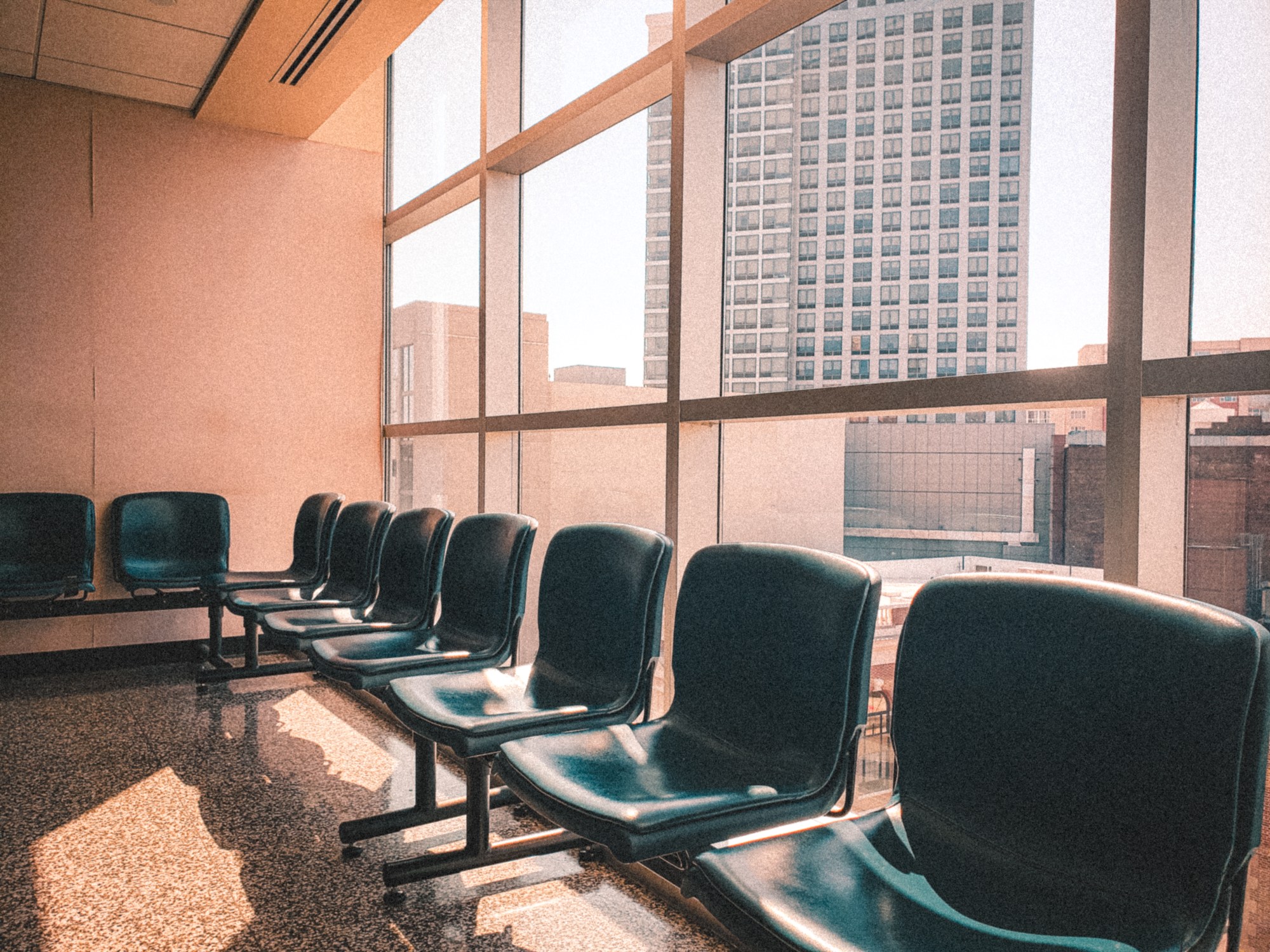
Featured Image: Lawrence Krayn “Waiting Room” – Instagram: Xquisite_Grit
 The Newarker