

By Jeanne Brasile
Visceral Bodies, the current exhibition at Gallery Aferro provides fresh and potent outlooks on a well-established art historical subject—the human body. Throughout time, the body has been invoked as a contested artistic space, conveying not just the likeness of the sitter, but the socio-political values of the time. In this extraordinary post-Covid moment, curator Juno Zago addresses renewed and reimagined considerations of the body as a site of discourse. Zago’s curatorial statement acknowledges this well-trodden thematic path in his treatment of the subject. Yet, he and his selected cohort of artists have found new and compelling conversations situated in the present moment.
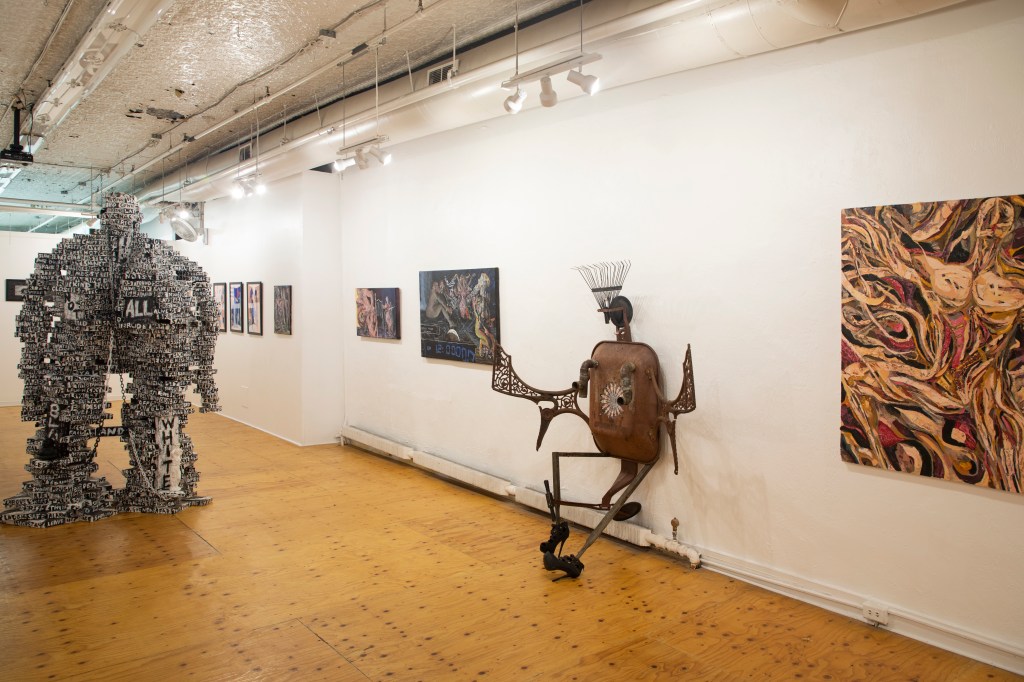
Installation view
The show opens with the uneasy domesticity of a constructed suburban life as depicted by Christine Sauerteig-Pilaar whose mixed media impressions of the female body convey a frustration with expectations women were taught to place on themselves or were placed on them by others. “Disintegration #5” incorporates sewing patterns against deconstructed imagery of female bodies and draped fabric that dissolve into topographical and anatomical depictions. Hung from a drapery rod, the piece is constructed by layers of paper and cloth that hang limply from the top before terminating in a pseudo bridal dress train that rests on the floor. The delicate and haunting take on domesticity is accentuated by the subtle palette that quietly and decorously waits acknowledgement by the viewer.
In the hands of Jackie Skrzynski, the body becomes a writhing landscape of stoma, skin, teeth, eyes, and indeterminate fleshy parts. Skrzynski’s large charcoal drawings are densely arranged bodyscapes that menacingly drip, pucker and gnarl across dark surfaces punctuated by areas of dramatically lit body parts. The dense imagery heightens the feeling of foreboding, denying the eyes and brain a chance to contemplate these arrangements of corporeal chaos. Dripping flesh and puckering orifices are rendered in areas of deep shadows butting against dramatically lit areas bursting with intestines and neurons. The overall effect brings internal and external spaces together, fusing them onto one plane.

Jackie Szkrynski- Bite, charcoal on paper, 50″ x 35″, 2017
Judy Giera’s alchemical mixed media works bring transgender narratives into focus with the inclusion of her two “Boobie” sculptures. Disarming and cheeky from a distance—like beckoning pink and yellow meringue flowers—her perkily constructed breasts hang on the wall, their half-orbs hanging one atop the other. On closer inspection, the breasts sport arrangements of hypodermic needles emerging from a subcutaneous region within. These needles were used by the artist as part of hormone therapy for gender affirming care. Giera’s adept use of color and mixed media bring a bit of visual levity to the conversation addressing the challenges of living in a transgender body.

Judy Giera- Boobie, yarn, styrofoam, 22g 1-inch needles used for intramuscular injections as part of Hormone Replacement Therapy for Gender Affirming Care, and epoxy resin, 5″ x 5″ x 3.5″, 2023
Health and medical concerns about the gross body are addressed in Nelle’s “Mastectomy” which presents an array of pre- and post-operative breasts arranged serially in a graphic style floating across a pink ground. Breasts, sutures and scars in all shapes, sizes and colors fill the canvas in an almost whimsical way. Nelle’s painting calls attention to breast cancer while pointing to the prevalence of the disease, its varied treatments and outcomes, and the diversity of people impacted by it.

Nelle – Mastectomy, acrylic on canvas, 24″ x 18″, 2022
Kerry Kolenut’s “MicroscopicStudy” series tackle health and biological issues in a less direct fashion. Black and white images on metallic paper resemble the stuff of petri dishes in a laboratory setting, a preoccupation and source of contention, particularly during the lockdowns of 2020 when science and public opinion were often in conflict.
It would be unfair to expect Visceral Bodies to address all the narratives encapsulated in our times. First one, the themes are unlimited and there is no gallery large enough to contain the subject. Juno Zago presents a narrative predicated on contested bodies in often indeterminate spaces, presenting a variety of human experiences and outlooks. Perhaps one can look to the artworks and see something familiar in them or see something unknown from a position of openness and empathy. The curator hits the right balance between conflict and productive discourse. We can all use a bit of that right now.
Jeanne Brasile is a writer, artist, curator, and yoga instructor living and working in Essex County. She is currently the director of the Walsh Gallery at Seton Hall University.
All photos in the article are by the author. Featured photo by Kevin Lau
 The Newarker