
By Matt Goias
The first known print usage of the term “bridge and tunnel”, referring to people, can be found in the December 13, 1977 edition of The New York Times.
Studio 54 nightclub owner and convicted felon Steve Rubell, told the paper, “On the weekends, we get all the bridge and tunnel people who try to get in.”
He clarified, “The people from Queens and Staten Island and those places.”
Just like that, a guy, born and raised in glamorous Manhattan, home to Wall Street and three of America’s wealthiest zip codes, created a classist cliché which remains in the national lexicon to this very day.
With the coining of that phrase, Rubell, the Syracuse-educated future art collector and multimillion dollar tax evader, helped codify a discriminatory ethos that actively excluded a great majority of the region’s residents, the ones who made the whole place “tick.”
“Bridge and Tunnel” has always meant, “Not Manhattan.”
After Rubell’s repurposing, “bridge and tunnel” was a pejorative whose blast range most definitely included Brooklyn, Queens, The Bronx, and Staten Island.
Although not explicitly uttered, “bridge and tunnel” also implied “New Jersey”.
Let me make this clear, I love New Jersey, but I don’t like the place one bit.
New Jersey is dense, tense, hot-headed, harried, sporadic, unstable, confusing, and cranky. Those are some of the state’s good qualities.
Dystopian stretches of industry smell of angel dust, brewery, sewage, and marshland. The cost of living is extremely high. There is too much traffic; dank, complicated, rubber-necked and jug-handled varieties of traffic. There is Bon Jovi.
There’s good stuff too.
You don’t have to pump your own gas. There is amazing pizza, bagels, Indian, Korean, Caribbean, Lebanese, and Portuguese cuisine. There is Skee Ball and Springsteen. There is Bon Jovi.
Normally, I would not be inclined to write about New Jersey.
Although I’ve lived most of my life in New York, I was born just outside of the city, in a place called Edison, New Jersey, only seven miles to the Outerbridge Crossing and New York City.
I mention being born in Edison because, to some native New Yorkers, it doesn’t matter if you moved to New York when you were three years old or three days old, you absolutely do not count as a true “New Yorker” unless you were born within the city’s five boroughs.
That is fair and I completely respect this parameter.
Even though I’ve spent a larger portion of my life living in the Empire State, as a Libra who happened to be born across the Hudson, part of me cannot help but to frequently advocate for the Jersey “Devil”.
It can however create friction.
Everybody hates New Jersey.
Like, people really hate the place.
Very often, the vitriol is spewed by people who come from far away, or people who’ve never even visited, other than perhaps a mis-booked flight out of Newark.
People diss New Jersey for sport, as if tradition. New Jersey frequently serves as the butt of jokes or gets tagged in played-out tropes and over-broad generalizations. Talk about a bad rep and a bad rap. New Jersey is literally a dirty word(s), they’ve nicknamed the place, “Dirty Jerz”.
Nobody ever “gets” Jersey and I get it, New Jersey is not an easy place to “get”.
It’s a weird place, hard to explain. But maybe it’s because nobody ever explains it correctly.
First of all, New Jersey-just-outside-of-New York City is a way different place than South Jersey and Jersey-just-outside-of-Philly, they could be completely separate states.
(That being said, Central Jerseyans are super grateful for Wawa’s 2013 expansion to Kearny, Woodbridge, and Elizabeth.)
A peculiar and volatile cauldron of ever-shifting elements and compounds, some of the negative conjecture thrown at New Jersey is certainly true.
In other respects, New Jersey is an important place that has played many critical roles in Art and World History throughout the 19th and 20th Centuries. To this day, the state continues to play an essential role within the mechanism of the Greater New York City Metropolitan Area and Mid-Atlantic Megalopolis.
Still, Jersey never seems to be able to catch any good press. The state has become a reliable and ever-ready permanent scapegoat.
Many of Northern and Central Jersey’s equidistant, New York counterparts, places in Brooklyn and Queens, have become “name brand hoods”, celebrated in popular song lyrics, permanently “cool” and impervious to besmirching. Although there are many communities, on both sides of Manhattan, that are almost identical in certain demographic statistics, the crossing of that state line creates a large and insurmountable psychological barrier to many.
There are those too, however, who see beyond invisible borders, beyond drawn-up government map lines. There are people who traverse the megalopolis with prolific frequency and speed.
The Tri-State Area is home to one of the greatest mass transit systems in the world, its iron horses stampeding across the region, over and through hundreds of bridges and tunnels. In our part of the world, it was easy for people and ideas to move about freely.
In All Up in the Biz, Sacha Jenkins’ 2023 documentary about the life of rap icon Biz Markie, numerous hip-hop luminaries ruminate on Markie’s omnipresence around New York City and Long Island.
Biz proudly admits, “I was known for being everywhere.”
De La Soul producer and Stetsasonic DJ Prince Paul marvels, “He was accepted [in] every group, in every neighborhood. I don’t know how he got around or what he did. I knew he took the Long Island Railroad occasionally. He was everywhere.”
Biz used the area’s rails and resources to slide, with ease, between Long Island and New York City’s five boroughs.
He made it out to New Jersey, too.
Elizabeth, New Jersey is the hometown of Author Judy Blume and to Biz’s DJ, Cutmaster Cool V. The port city’s Vogel’s Records, is prominently featured in in Markie’s 1988 “Vapors” video.
In many instances, New Jersey plays an important shadow role in popular culture.
New Jersey serves.
Elizabeth and Edison are both located in Central New Jersey.
For decades, there was great (humorous) debate over whether or not a place called “Central Jersey” actually existed at all. Some (jokingly) believed New Jersey was comprised of only northern and southern hemispheres. The people who lived in the slash across the middle felt differently.
In 2018, New Jersey Governor and Central Jersey resident, Phil Murphy tried to put the issue to bed by publicly proclaiming, “WE are one New Jersey: North, Central, and South.”
That same year, during an appearance on The Late Show, Murphy explained the Garden State’s famously spicy center to host, Stephen Colbert. Describing Central New Jersey, Murphy said, “It’s a little bit of a mystical kingdom, kind of a camelot.” He added, “It’s definitely maybe Narnia.”
In the same Late Show segment, Colbert’s old friend, comedian Jon Stewart declareth, “Central Jersey does exist. I grew up there.”
Throughout the 1980s, just across the river, in its homebase of New York City, Hip-Hop culture thrived. Englewood’s Sugar Hill Records played a significant part in this, but that’s another essay altogether.
At the end of the 80s, however, something else, something new began to brew.
By 1990, emerging rap talents like Biz Markie, Eric B & Rakim, Public Enemy, EPMD, De La Soul, Heavy D & The Boys, K-Solo, DMX, Poor Righteous Teachers, Naughty By Nature, Chill Rob G, Lakim Shabazz, and Queen Latifah, were evidence that hip-hop culture had spread-out to the so-called “suburbs”, without any signal distortion.
Hearing the production work of collectives like Long Island’s Bomb Squad or Hit Squad crews, or New Jersey’s Flavor Unit, it’s not unreasonable to say that the signal may have even gotten a little stronger and louder.
Hip-Hop was indeed expanding, but so was Greater “New York”.
In the 1990s, in the years just before the world got “smaller” via ubiquitous internet access, the Greater New York City Metropolitan area got “bigger”, population-wise, as 2 million new people became densely settled throughout the area.
The Outer City.
According to the US Census and a study put together by the Federal Reserve, during the 1990s, “more than 1.3 million people left New York City for nearby suburbs and other states even as 1.2 million foreign immigrants flowed into the city.”
The report reminds us, “This ‘cycling’ of the population, with a large influx of immigrants replacing a similarly large number of outgoing residents, has a long history in New York.”
New York City is the “big show”, the “main event”, and as it expanded, the production started to require a significantly larger backstage area. The people, the machine’s microchips, bots, and cogs, all needed someplace affordable to rest their heads at night.
Places like Westchester, served by the Metro North commuter rail lines, Long Island, served by the LIRR, and Central Jersey, situated perfectly along New Jersey Transit’s Northeast Corridor commuter line, dutifully served this purpose.
In the 1980s – mid-1990s, coinciding (and “chemically reacting”) with these mass movements of citizenry, Generation X (the sizable demographic of people born between 1965 and 1980) started to come of-age and their parents (our parents) were nowhere to be found. Pumped chock-full-o Reaganomics and “Go-Go 80s” ambition, many moms and dads were out “taking the world by storm”. Others struggled to recover from earlier recessions and economic hard times. Generation X has often been called the “least-parented generation”.
This ginormous swarm of detached and unsupervised latchkey kids, roaming the streets, were the perfect pathogens necessary to create and spread an unprecedented amount of viral, countercultural youth movements.
The angst and energies generated by Generation X’s coming-of-age years concocted an alchemy that spawned subcultures including Punk Rock, Glam, Hip-Hop, Metal, House Music, Ballroom, Voguing, “Club”, the Club Kid craze, Goth, Second and Third Wave Ska, Dancehall, Freestyle, Techno, Rave, Jungle, Straight Edge, Acid Jazz, Hardcore, Emo, Neo-soul and a million other game-changing micro-movements that still inform pop culture to this day.
The area’s famously efficient subways and trains connected the workers to the jobs, but they also connected the youth to the youth, pollinating a (probably) historical amount of these extremely powerful “scenes” and subcultures.
There were the tales of Hip-Hop’s Biz Markie frequently navigating from Long Island, to The Bronx, to Brooklyn, to Elizabeth.
Faithful congregants of the House music scene gathered at Newark’s legendary Club Zanzibar and weekly parties throughout NYC.
Punk and Hardcore fans dutifully followed their bands from the Lower East Side, to New Brunswick’s Scott Hall, to Trenton’s City Gardens, to The Anthrax in Connecticut, and countless venues up and down the east coast.
Techno ravers raved in Brooklyn, Queens, Manhattan, Jersey, Poughkeepsie, Long Island, Rhode Island… the ravers partied everywhere.
Ultimately, many of these movements’ “final forms” were honed and refined (then, often packaged and sold) in Manhattan.
New York City may be where the sausage is made, but the lips and assholes come from all over.
“The City” was always a grand marketplace and salon, its downtown, a nucleus of creative activity and innovation. It’s where everyone from everywhere met up to trade goods, looks, and ideas, where everyone went to seek refuge and compare notes.
In 2023, after hearing news that monthly, downtown culture bible, Paper Magazine, was closing, I began reflecting on my short but meaningful time at the magazine, first as an intern, then eventually as a salaried employee.
Paper meant the world to me, long before I started working there.
Beginning in the late eighties, a few forward-thinking, independent periodicals, served as roadmaps and priceless cultural tutors, showing us how it all worked, laying out how all of these different, young people scenes all fit together. When it came to the common, rare, and far-flung ingredients of Gotham’s creative gumbo, publications like Paper, Details, Interview, The Village Voice, Project X, On the Go, and Ego Trip helped reveal the recipe and made it all make sense.
These magazines were crucial to my education, entering my consciousness during an important stage in my life and a special time in the history of pop culture.
These publications also made it clear that it’s impossible to write about most, cool “New York City” stuff without also mentioning the areas just outside.
If you were going by Steve Rubell’s New York Times definition of the term, it was impossible to talk about the coolest “New York City” stuff without talking about that “bridge and tunnel” crowd.
Andy Warhol was from Pittsburgh, a town famous for two things, being the hometown of Andy Warhol, and for having one, whole, entire fuckload of bridges.
Steely Dan, a band known for their literary-leaning “New York City” cool, is comprised of New Jersey’s Donald Fagen and Westchester County’s Walter Brecker.
Hip-hop was pioneered up in The Bronx by Jamaican immigrant, Kool Herc.
Blondie’s Debbie Harry was born in Miami and raised out in Jersey.
Jean-Michel Basquiat was from Brooklyn (four bridges, one tunnel).
The Ramones came from Queens, a place whose residents, according to Rubell, probably wouldn’t have been welcome within Studio 54’s velvet-roped doors.
(Although in acclaimed documentary, NY77, Ramones dummer, Tommy Ramone, describes a post-fame visit)
With no disrespect whatsoever towards any New York City “natives”, it’s hard to ignore the fact that a healthy number of icons, often closely associated with New York City, are actually from “someplace else”… often from “just right outside.”
Let’s have a look at something called the New York Knicks 2026 NBA Championship…
Jalen Brunson was born in New Brunswick, New Jersey and Karl-Anthony Towns was born in Edison.
At one point, during New Jersey Governor Phil Murphy’s Late Show television appearance, Colbert began ribbing Murphy about the seemingly non-existent identity of the middle of the state. Murphy (a wealthy, Massachusetts-born politician) didn’t seem to have any great responses to Colbert’s implications.
Transplant Murphy’s lack of educated response took me aback. He had so much ammo that he probably didn’t even know about.
Central Jersey has many, very specific, very powerful, well-seasoned, game-changing, enlightening, explosive, and table-turning characteristics. The turntable, necessary for the creation of Hip-Hop, was invented in Edison, for example.
Five years after that appearance, in August of 2023, during the same month in which Hip-Hop was celebrating its 50th anniversary, Murphy signed a decree, officially making Central Jersey an actual place that exists.
This strange pizza slice of the world functions with an awesome interconnectivity and occasional interdependency of the communities within the region, especially the neighborhoods and towns along the heavily traveled transit lines.
Throw a body / heart / veins / arteries metaphor in here somewhere, anywhere you want.
Everything works together.
Some of the best pictures of the city were taken from across the river and the best song about New York is sung by a guy from New Jersey.
Matt Goias is a New Jersey-born writer, photographer, and artist. You can find him at www.mattgoias.com and @matt_goias.
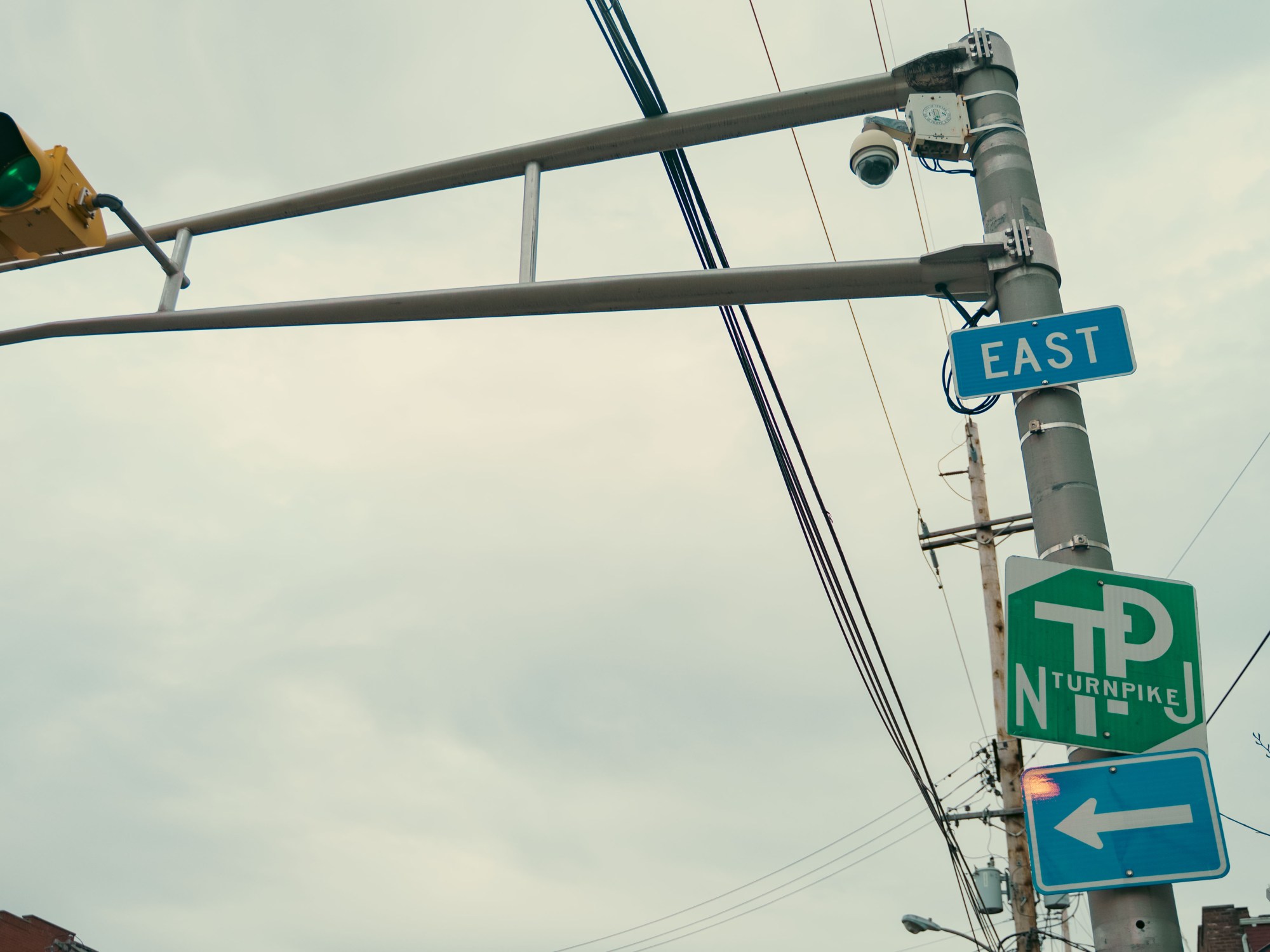
Featured Image: Kris Charlery. A multidisciplinary artist and photographer based in New Jersey whose work explores the intersections of community, environment, and memory. Her recent project, The Anderson Project, was featured in the 2024 Newark Arts Festival and supported by the New Jersey State Council on the Arts as a 2024 Grant Finalist. Through portraiture and storytelling, Charlery documents the people and places. Instagram: thestargardenstudios Website: https://krischarlery.photoshelter.com/index/G0000jeeFuazsMWE

