
By Alicia Cook
No matter where I am in New Jersey, and often well beyond it, there is always a sign pointing me home.
Literally. Sometimes it’s small, easy to miss if you’re not looking for it. Sometimes it’s massive, hovering over lanes of traffic in reflective white letters: NEWARK. Five miles away or a hundred, I always find a Newark sign. I often say it out loud, half joking, half certain: I’ll never get lost. I’ll always get home. Again, literally. Even without a GPS, even without a plan, I trust that the signs will do their job.
My family’s roots in Newark run deep enough that directions feel inherited. My father was born and raised in the Ironbound, Brill Street. My mother grew up in the North Ward, anchored by the Cathedral and Branch Brook Park. The Newark Fire Department has been a constant in my family, less an institution than a throughline, a reminder that some forms of service and commitment endure across generations.
I lived in the Ironbound myself for many years, first by Krug’s and then a few feet from Nasto’s, before buying the North Ward home my mother grew up in, after the last relative who had lived there passed away. I’ve been in the house for more than ten years now. My mother often comments when she visits, “I even think the house is happy.” I don’t talk about it as settling down; it feels more like settling in. I have no real intention of leaving.
Every single day, I pass through Branch Brook Park. The park changes constantly—bare branches, green canopies, falling leaves—every season is my favorite. For about three weeks each spring (Cherry Blossom Season), I joke that everyone suddenly wants to visit Newark. The traffic in my neighborhood swells in a way I usually associate with shore towns in July. Out-of-town cars crawl along Lake Street, Heller Parkway, and Park Ave. Visitors wander, wide-eyed, as if surprised by beauty they weren’t expecting to find here. Then the blossoms fall, the crowds thin, and the park returns to those of us who never left.
Along one of my usual run routes sits a bench with a plaque that reads: “To a city that gave America its underpinnings and my family its start.” Amen. Newark has always been an underpinning kind of city—industry, labor, shipping, immigration—the framework beneath other people’s prosperity. It taught America how to work, and families like mine how to begin.
When I tell people where I live, the reaction is rarely neutral. Sometimes there’s a pause, an annoying look shaped by whatever version of Newark they’ve absorbed from afar. Other times, a light goes on. They tell me about streets they used to walk, bakeries they loved in the ’80s. They remind me that the light rail used to be called the subway. The “good old days” stories come pouring out. Usually from people who haven’t even been back in 30 years.
Newark lives in people with remarkable specificity. That’s what fascinates me. Newark inspires this kind of memory more than most places. People remember it viscerally: corners, food, shortcuts, habits. I think it’s because Newark has always asked something of the people who passed through it, be it work, attention, or participation.
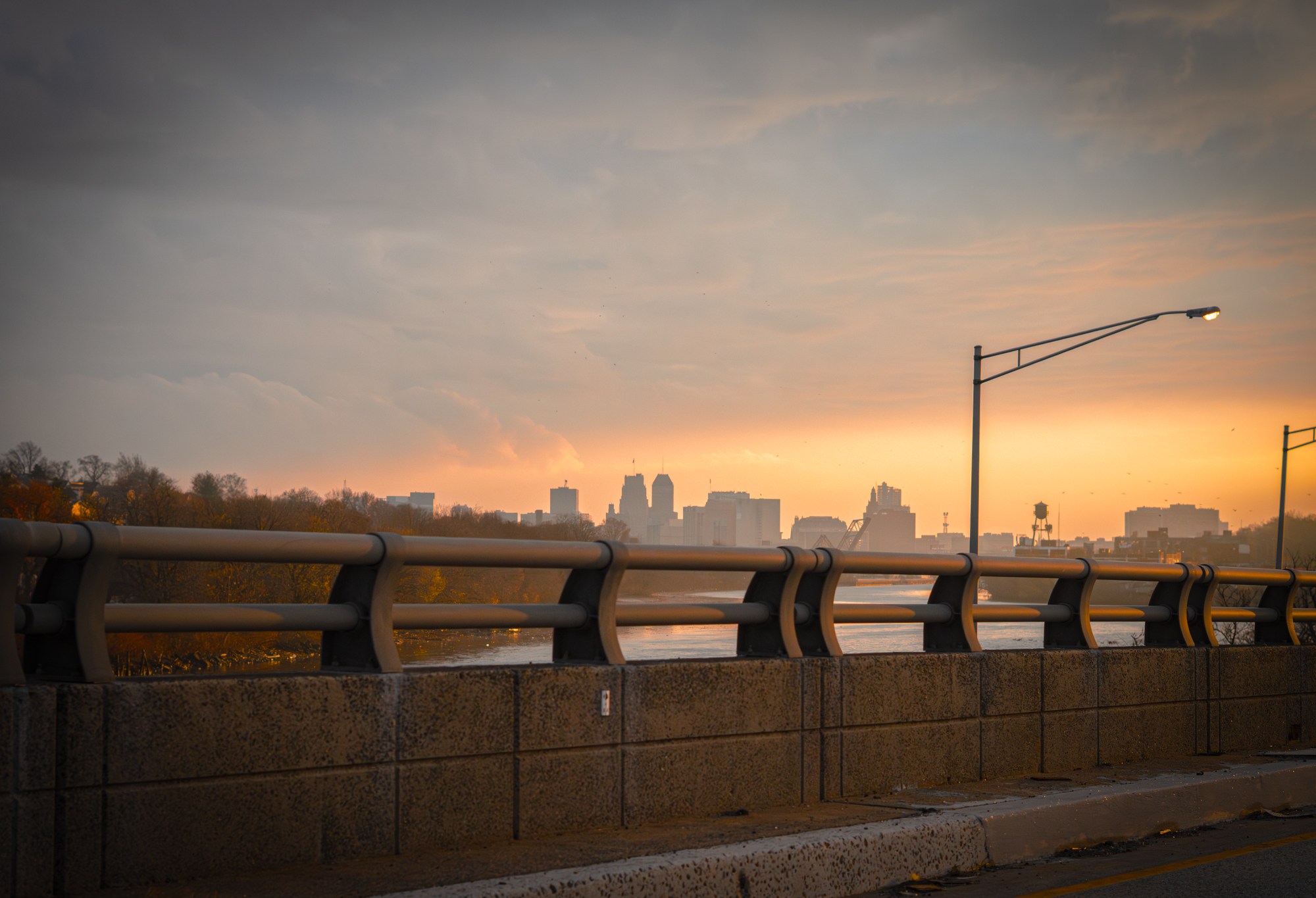
Newark is an experience. And unlike skylines, experiences don’t disappear when the city changes. Those road signs pointing home feel like an acknowledgment of that permanence. You don’t orient yourself toward something insignificant. You don’t measure distance from a place that doesn’t matter. Newark remains a reference point, whether people realize it or not.
I still hear my own voice sometimes when I’m driving, echoing that old certainty: I’ll never get lost. I’ll always get home. Roads radiate outward from Newark, but they also curve back toward it. History does the same.
And maybe that’s why I like teaching people how to say it properly. You can always tell who’s from here by the way they pronounce it. Not New-ark. Not carefully enunciated. Just Nork! Quick, familiar. One syllable, not two. A word you don’t have to think about because you’ve been saying it your whole life.
All roads lead to Newark. How lucky am I?
Alicia Cook is a multi-award-winning writer and mental health advocate from Newark, New Jersey. Her poetry and essays explore addiction, grief, and hope, and have been adapted for music and dance. She is the author of multiple poetry collections and her work has appeared in The New York Times, Rattle, Writer’s Digest, HuffPost, and elsewhere. She is the winner of the 2026 Central Avenue Poetry Prize. Her website is www.thealiciacook.com, and her Instagram handle is @thealiciacook.
Featured image: Lawrence Krayn, Instagram: Xquisite_Grit

